
Project Summary/Scope:
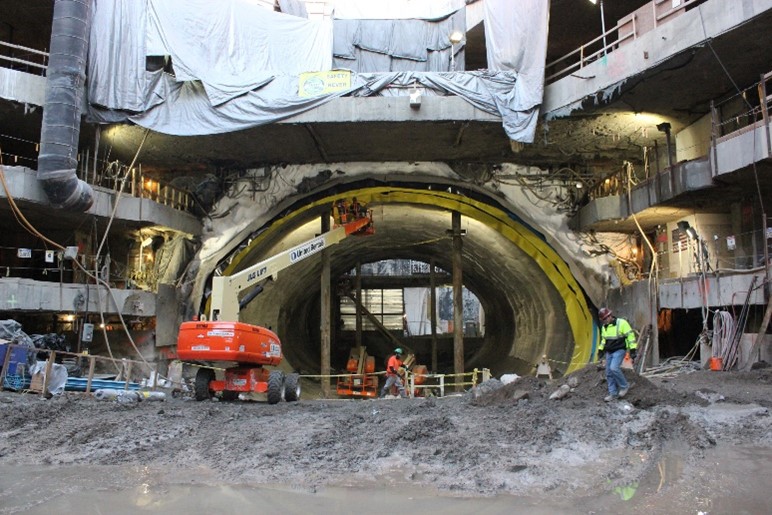
The CQ039 Northern Boulevard Crossing contract was part of MTA Capital Construction’s East Side Access Project connecting the Long Island Rail Road with NYC’s Grand Central Station. This contract required the construction of a sequential excavation method tunnel between two 85- foot deep access shafts, 120 feet apart. Challenges included working as deep as fifty-five feet below the groundwater table while hand-mining through variable subsurface conditions as discussed below with preclusions to dewatering and settlement. In addition, the tunneling would occur directly beneath an active subway line, an elevated rail line, both supported on piles, and Northern Boulevard, a main artery through Queens, New York. In order to create both a groundwater cutoff and a temporary excavation support during the tunneling operations, the tunneling contractor selected an artificially frozen soil arch, extending horizontally between the two access shafts.
The design process included structural analysis to ensure the frozen arch would have sufficient strength to act as temporary structural support during excavation and thermal analysis to determine the required freeze pipe number, spacing and temperature profile. The proposed ground freezing system would encompass five very different ground strata ranging from very soft silty sands, dense glacial till and granite bedrock. Extensive unfrozen, frozen and thawed soil testing was performed to determine such variables as frozen soil strengths, expansion factors, settlement potential and time dependent creep factors. Based on the results of the design process, the frozen arch was required to be a minimum of six feet thick with an average internal temperature of –10ºC. Comprehensive thermal analysis was conducted using finite element heat transfer software Temp/W determining that forty-three freeze pipes installed on 1.1 meter spacing would provide the necessary heat extraction to meet the aggressive schedule.
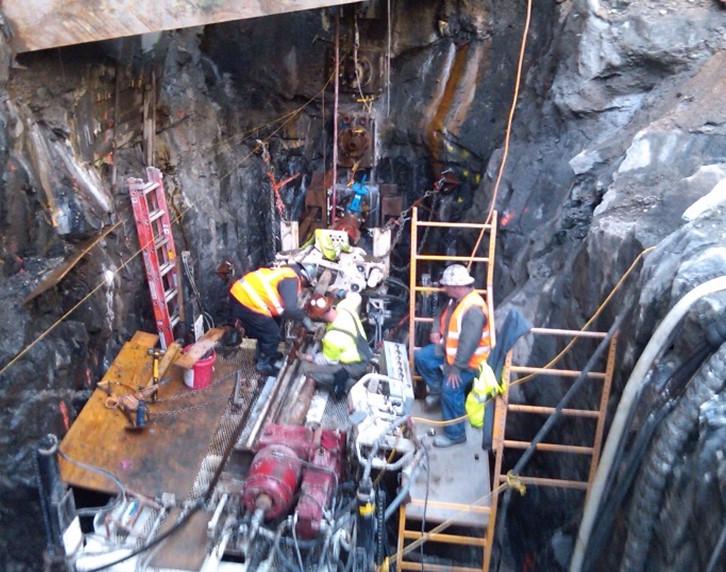
Horizontal boreholes would penetrate the two access shaft slurry walls in varying depths from twenty to fifty-five feet below the groundwater table. Given the nature of the silty sands to flow under these conditions it was critical for the drilling to be performed utilizing a groundwater control device consisting of steel trumpets cored and mounted in the slurry wall. Attached to each trumpet was a combination of chambers, valves, and seals that allowed drilling to occur with minimal to no soil loss.
Track mounted dual rotary drill rigs and horizontal skid mounted coring rigs were utilized to drill the boreholes. It was anticipated that obstructions including boulders, jet grout, concrete filled steel pipe piles, slurry wall reinforcement, and rock would be encountered. As a contingency, a horizontally mounted sonic drill rig was procured and would have been used if conventional drilling was unsuccessful at penetrating an obstruction.
Preconditioning of the soft soils above the frozen arch was conducted using over 60,000 gallons of non-cementitious void grouting to allow for more predictable settlement and heave. Twenty-two combination compensation grout/heat pipes were then installed above the arch. Tube-A-Manchette (TAM) pipes were used to allow for repeated injections of both cementitious and non-cementitious grout and the installation of heating elements to control the growth of the freeze. A trial grout program was successfully conducted by demonstrating the ability to lift the subway structure as measured by prisms inside the structure.
Over the course of twelve months working 24 hours per day, a total of sixty-two freeze pipes were installed from both the north and south shafts. In addition, four vertical freeze pipes, one vertical temperature monitors, four horizontal temperature monitors and three horizontal drainage wells were installed to track and verify the effectiveness of the ground freezing process.
All freeze pipes were connected to a common supply and return piping system which could circulate low temperature brine from a refrigeration plant through each freeze pipe at a rate of twenty gallons per minute. A single refrigeration plant with a rating of 312 tons of refrigeration was utilized. The freeze plant used ammonia as a primary refrigerant to chill calcium chloride solution to between -25 to -30 degrees Celsius. Refrigeration was accomplished with two, 400 horsepower electrically-powered compressors contained within the custom-made freeze plant manufactured specifically for ground freezing operations.
Approximately twenty weeks of freezing was needed to form the frozen arch. Constant data acquisition of brine temperatures, ground temperatures and groundwater levels was maintained. The pressure inside the forming frozen arch was monitored with the use of transducers within the arch. A gradual increase in groundwater pressure inside the arch would indicate that the frozen mass had achieved closure. Groundwater levels were also measured in a series of vertical piezometers across site.
The ground freezing system operated as designed for approximately 455 days, during which time the tunnel was successfully excavated, lined and waterproofed without delay.
Complementary Technologies Used: Compaction Grouting, Permeation Grouting
Alternate Technologies: Cut and Cover

Performance Monitoring: Ground temperature, groundwater elevations and freezing plant operating data were continuously monitored.
Cost Information: Cost information is confidential and not available
Case History Author/Submitter: Schmall et al. (2013)
Project Technical Paper: Schmall, P., Madsen, P. and Pepe, F. Ground Freezing for the East Side Access Northern Boulevard Crossing – Balancing Settlement and Heave Control, 2013, Rapid Excavation and Tunneling Conference, Washington, D.C.
Date Case History Prepared: November 2022