
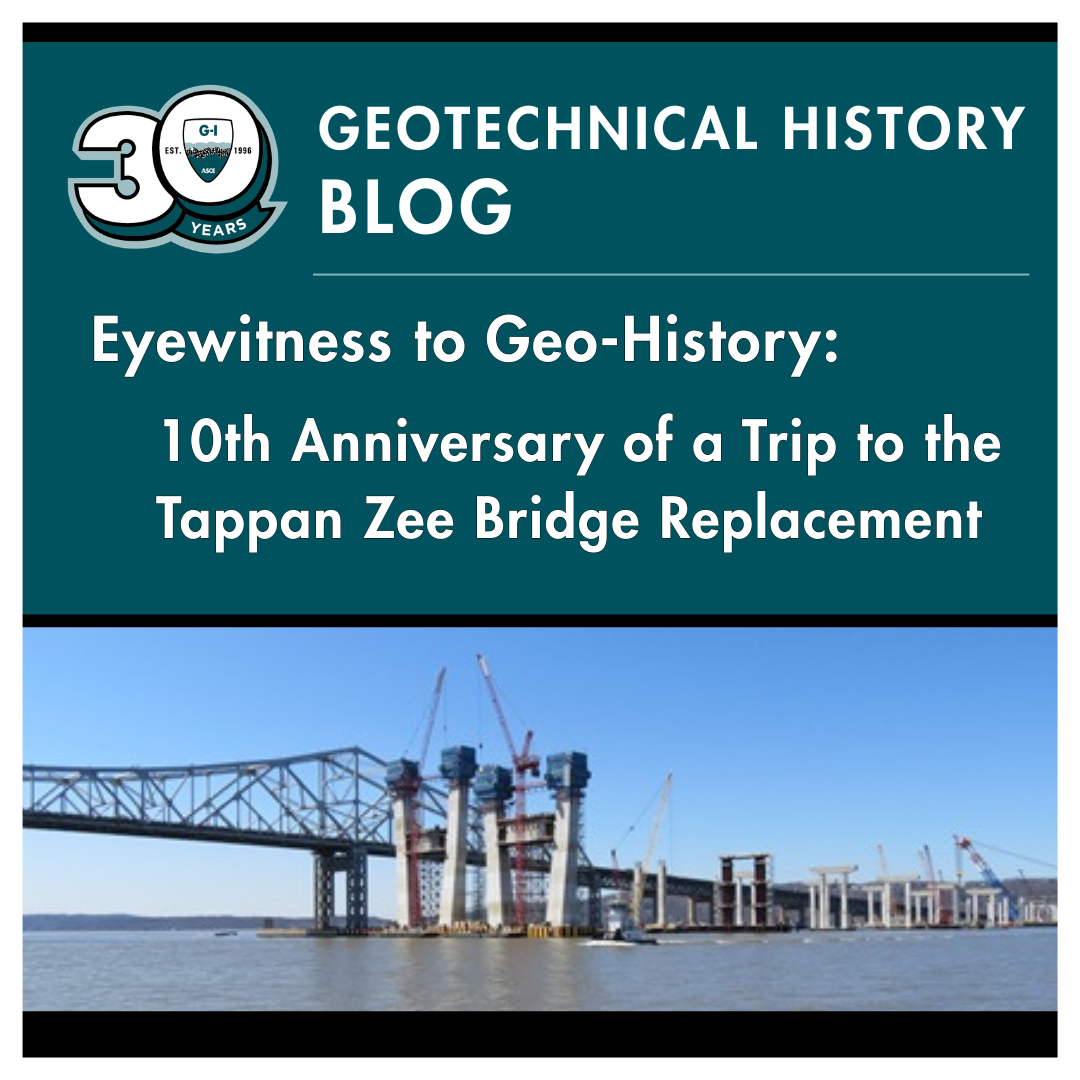
Eyewitness to Geo-History: 10th Anniversary of a Trip to the Tappan Zee Bridge Replacement
By Michael Bennett, P.E., S.M.ASCE (Virginia Tech: Blacksburg, VA)
Author’s Note: This piece is dedicated to the late Prof. Dave Veshosky of Lafayette College, a wonderful teacher and even better person.
The pleasant irony of pursuing a geotechnical career while also blogging about the field’s history is that my own experiences gradually become part of that history. I first experienced this a decade ago along a 3-mile-wide stretch of the Hudson River just north of New York City. It has been known since Henry Hudson’s time as the Tappan Zee; the Tappan tribe of Native Americans inhabited the region, while the Dutch “zee,” meaning “sea,” recognizes the river’s width. Drivers usually cross the Hudson here to avoid the frequent snarls of Big Apple traffic. The current structure, completed in 2018, replaced one dating to the 1950s and the construction of the New York State Thruway. The new span, officially named the Governor Mario Cuomo Bridge but commonly called the Tappan Zee Bridge or “the Tap,” is visually and technically impressive. Eight 419-foot-high towers support cable stays and 12-foot-deep main girders that hold aloft 10 lanes of traffic, while over 1,000 piles support the structure beneath the river bottom (American Bridge 2018, Berger 2017, High Steel 2023).
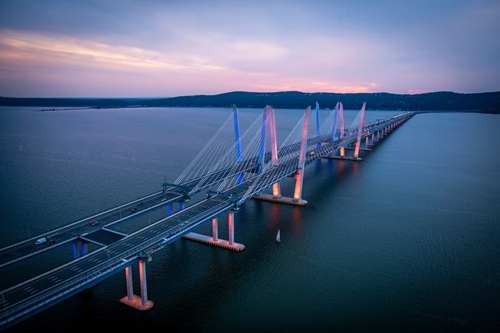
The present Tappan Zee Bridge’s immense dimensions make its relative novelty easy to forget. Just a decade ago, in April 2016, it was still being built, and its predecessor was still carrying traffic. I visited the site that month as a junior-year civil engineering student at Lafayette College in Easton, PA. For the annual MOLES trip, our civil engineering juniors always joined peers from other institutions in or near greater New York to visit a major regional construction project. That year’s destination was the new Tappan Zee Bridge. Although I was busy studying for my FE exam later that month, I wanted to be prepared for a field trip to such a significant project. So, on the eve of our junket, I read a recent issue of Engineering News-Record (ENR) devoted to the bridge’s replacement.
5:00 AM on Friday, April 15th, came much too early for my classmates and me, but we gamely stumbled out of bed and over to a waiting coach bus. Our chaperones, Profs. Dave Veshosky and Dave Brandes, reaffirmed why we students widely liked them when they brought us coffee and donuts to make up for the dining halls not having opened yet. Thus fortified, we talked, read, and – for many – napped our way through the 2-hour ride across New Jersey, past Gotham’s suburbs, and through the Lincoln Tunnel to a ferry docked in Midtown.
Boarding the boat, we joined peers from other schools such as our friendly arch-rival, Lehigh University. However, everyone’s eyes were almost immediately drawn to the cadets and future officers from the US Military Academy. The West Pointers sported neat haircuts, sat with ramrod straight postures, and had every button on their camouflage uniforms in place. They contrasted sharply with the rest of us, who were shaggier, more casually dressed, and slumped drowsily in our chairs. I observed several of my classmates who were regular gym-goers discreetly checking their own muscles against those of the cadets!
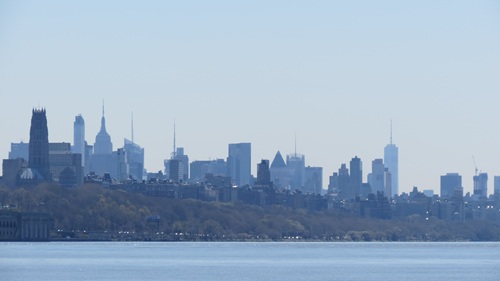
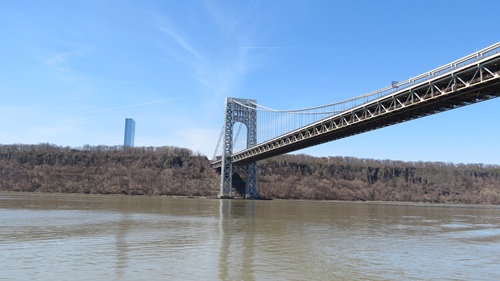
Meanwhile, as we started our journey, representatives of the bridge’s owners, the New York State Thruway Authority, stepped to waiting microphones. They walked us through the project’s basics, including the question everyone had in mind: Why build a bridge at the Hudson River’s widest point? The answer was a clear example of the non-technical considerations civil engineers handle on their projects. The Thruway folks explained that the Tappan Zee was the southernmost point at which Hudson River crossings would be under their agency’s jurisdiction instead of the Port Authority of New York and New Jersey. As they outlined this, we whizzed past Big Apple landmarks such as the Empire State Building, Grant’s Tomb, Riverside Church, and the George Washington Bridge. The sun beamed down on a spring morning that was shaping up to be beautiful, if not necessarily balmy (Berger 2017).
Leaders from the project engineering team then segued into the job’s technical aspects. Those of us taking Lafayette’s Foundations and Earth Pressures elective that semester, like me, found the project’s geotechnics to be particularly interesting. Borings for the bridge had been painstakingly sampled from barges on the Hudson River and had reached hundreds of feet beneath its bottom, which was already quite deep at the Tappan Zee. These borings had revealed soft soil deposits extending over much or all of that depth, and several borings hadn’t even encountered bedrock. Thus, the project team had opted to support the new structure on circular friction piles up to 6 feet in diameter and as much as 330 feet long (ENR 2016).
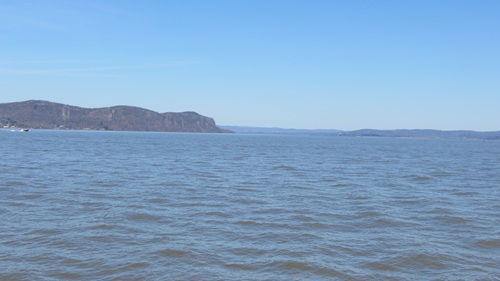
Driving these piles brought another non-technical challenge into play. The lower Hudson River is populated by a vulnerable species of sturgeon, and these fish are particularly sensitive to the loud noise and intense vibration that typically accompany pile driving. Before we could wonder just how loud and intense, the Thruway Authority emissaries played a brief recording of the unmuffled sound of such a large pile being driven. BANG! BANG! BANG! The audio rattled everyone’s eardrums and roused those of us for whom the coffee hadn’t been effective. The project team had mitigated this acoustic obstacle during driving by wrapping the circular piles in immense bubble curtains, presumably with “sturgical” precision.
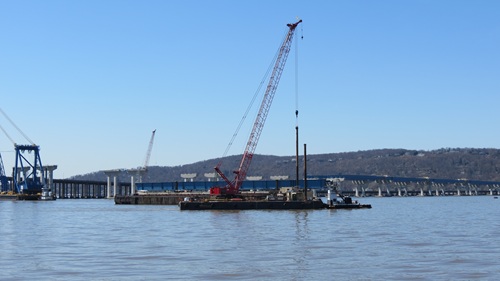
The structural aspects of the new Tappan Zee Bridge were at least as interesting as its geotechnical details, even to those of us planning on non-structural careers. All of us who had crossed the old bridge knew it was a technological marvel rather than an aesthetic one. Prof. Veshosky had explained in our Project Management course that it had been built amidst a national materials shortage following the Korean War. As a result, it was fracture-critical. By contrast, the new bridge was shaping up to be both functional and beautiful, as reflected in computer renderings of its twin spans and looming cable stay towers. It incorporated redundant elements and would also support a bicycle and pedestrian path, allowing locals to more readily enjoy the Tappan Zee’s natural beauty. Moreover, the new bridge had also been designed to support two light-rail tracks in the likely event that commuter train service was extended to the area – a nice touch to support multimodal transit. The new bridge was designed to last for 100 years, double the intended lifespan of its predecessor.
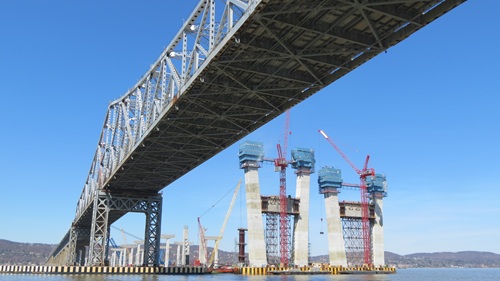
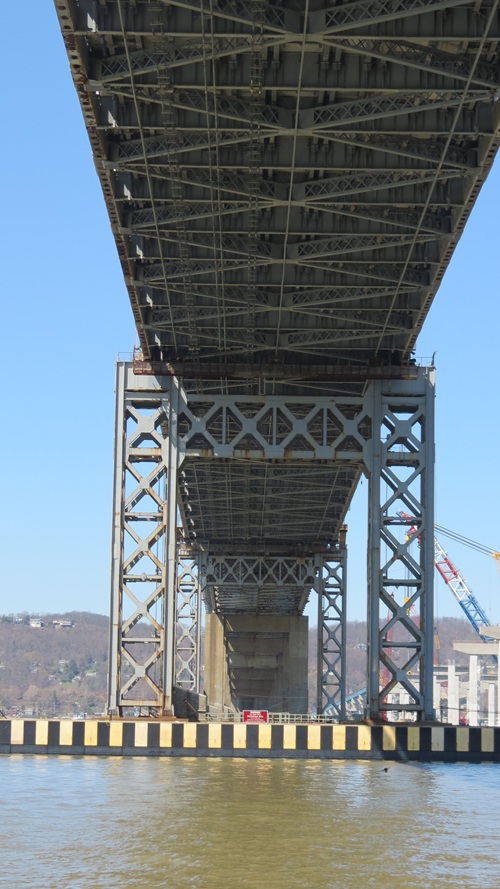
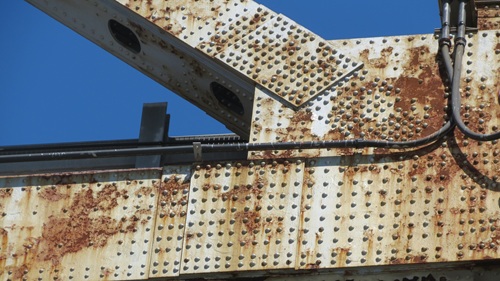
Our boat chugged along at a surprisingly brisk clip as our hosts provided all this background, and we soon reached the project site. The old bridge’s faded glory was apparent and striking. One could readily imagine it in its youth six decades earlier during the era of chrome tailfins, sugar cube polio vaccines, the advent of the Interstate highway system, and – 20 miles to the south – the marvelous outfield prowess of Willie Mays, Mickey Mantle, and Duke Snider. Now, in its waning days, the bridge had instead become an eyecatcher due to its rusting girders, peeling paint, and congested traffic. Like an aging sports star – such as Willie, Mickey, and the Duke late in their careers – awesomeness had slipped into adequacy, and “the Tap” was merely holding down the fort until its replacement was ready.
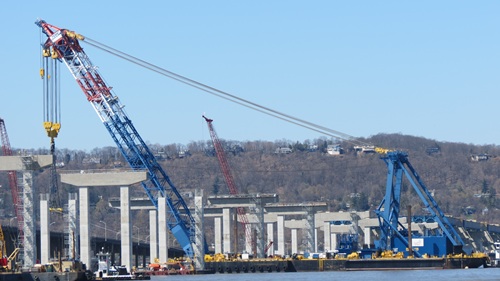
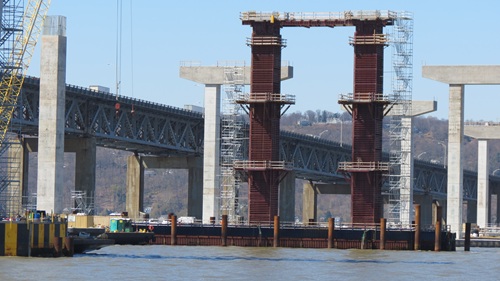
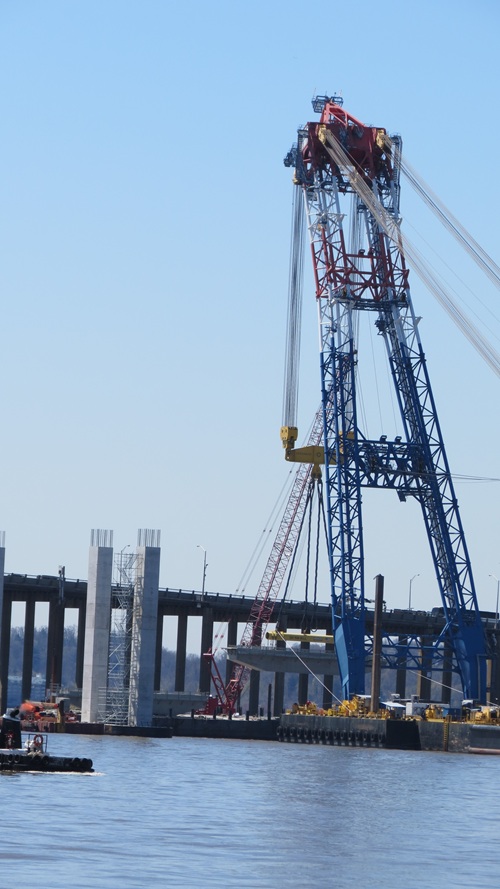
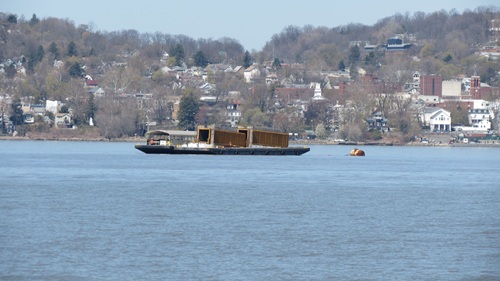
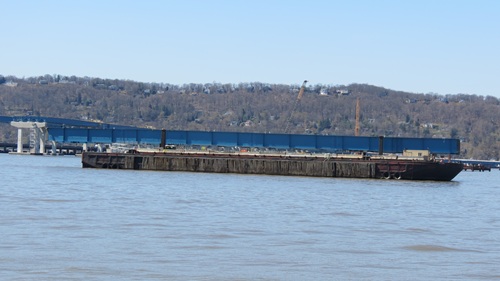
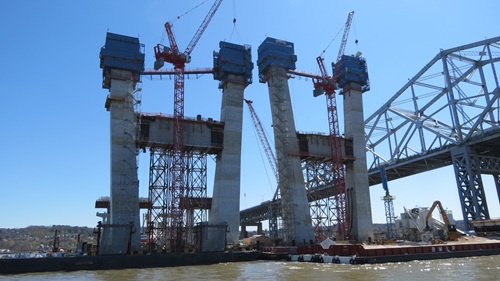
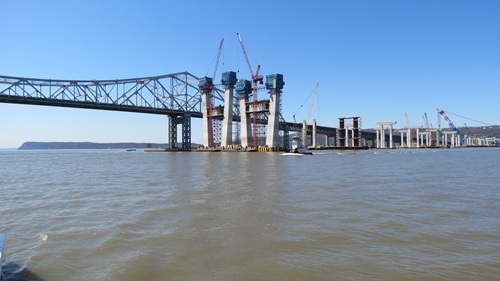
Plenty of work on that process was underway during our visit. The main spans’ bents were still under construction, but concrete cap beams already sat atop several of the approaching ones, and cranes were placing a few more. Barges bustled along the Hudson River’s formidable currents, hauling formwork for additional bents and steel girders for the deck. Concrete plants built atop barges anchored in the Tappan Zee met the new structure’s considerable demand, and mazes of scaffolding attested to the project team’s commitment to worker safety. Banners hanging from the new bridge flew the logos and emblems of the various engineers, contractors, and unions on the project and spoke to the team’s rightful pride in its ongoing accomplishment.
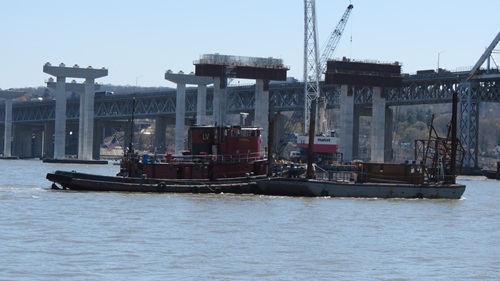
Images 10 through 14: Construction shots of the new Tappan Zee Bridge during the tour. Source: Author.
I
All work and no play makes Jack a dull civil engineering student, of course, and we had plenty of time for lighter-hearted activities on the voyage as well. We enjoyed a delicious lunch spread, during which some classmates and I chatted up the Thruway Authority representatives. The weather warmed a bit, and we students spilled out onto the decks and took in the lovely scenery of the lower Hudson Valley. Two of my classmates cracked everyone up by reenacting Jack and Rose’s famous stance from Titanic on our boat’s bow. Meanwhile, I was preoccupied with another historic vessel, a crimson tug named the Cornell. It bore the logo of the long-defunct Lehigh Valley Railroad, which had run through Easton. Later, I learned that the tug dated to the days when most railroads serving the Big Apple had terminals in Hoboken or Jersey City. From there, boats such as the Cornell had towed barges bearing passenger cars across the Hudson to separate terminals in Manhattan.
At length, the tour came to an end. Our good ship and true zipped back down the Hudson and dropped us into Midtown, whence our bus whisked us home to Easton. I was wiped by this time, most likely from the early start but also perhaps from the ecstasy of seeing the Cornell. Somewhere just past Newark, I paid another field visit, this one to the Land of Nod. I awakened only as the bus climbed College Hill to return us to campus, where the usual retinue of homework assignments, choir rehearsals, and FE study sessions awaited my return.
A lot of water has gone under the Tappan Zee Bridge since our MOLES trip 10 Aprils ago. Our class graduated the next spring and is now scattered across the country, globe, and professional world. Prof. Veshosky has sadly passed away, but Prof. Brandes continues instructing future civil engineers at Lafayette. At the Tappan Zee, the original bridge has been demolished, replaced by the successor we witnessed being built. The trip remains an enjoyable memory from my college years, and I grin when I remember it. I didn’t have to dig into vintage books or musty archives to connect with my field’s history that bright spring day on the Hudson River. Instead, I could see it being made with my own eyes.
References
American Bridge. 2018. “Original Tappan Zee Bridge.” American Bridge. Accessed Apr. 3, 2026. https://americanbridge.net/featured-projects/original-tappan-zee-bridge/
Berger, J. 2017. “Bridge of grand ambitions is set to open at the Tappan Zee.” New York Times, Aug. 24. Accessed Apr. 3, 2026. https://www.nytimes.com/2017/08/24/nyregion/tappan-zee-bridge-opening.html
Cho, A. 2016. “The New NY Bridge over the Hudson River is halfway to finish.” Eng. News-Record, Mar. 16. Accessed Apr. 3, 2026. https://www.enr.com/articles/39059-the-new-ny-bridge-over-the-hudson-river-is-halfway-to-finish
HDR. 2026. “Governor Mario M. Cuomo Bridge (Tappan Zee Bridge replacement).” HDR. Accessed Apr. 3, 2026. https://www.hdrinc.com/portfolio/governor-mario-m-cuomo-bridge-tappan-zee-bridge-replacement
High Steel. 2023. “New Tappan Zee bridge: The largest transportation design-build project in U.S.” High Steel. Accessed Apr. 3, 2026. https://www.high.net/our-company/what-we-do/tappan-zee-bridge/